
The Machine Cannot Think From Your Place
Arendt belongs near the center of our conversation about AI

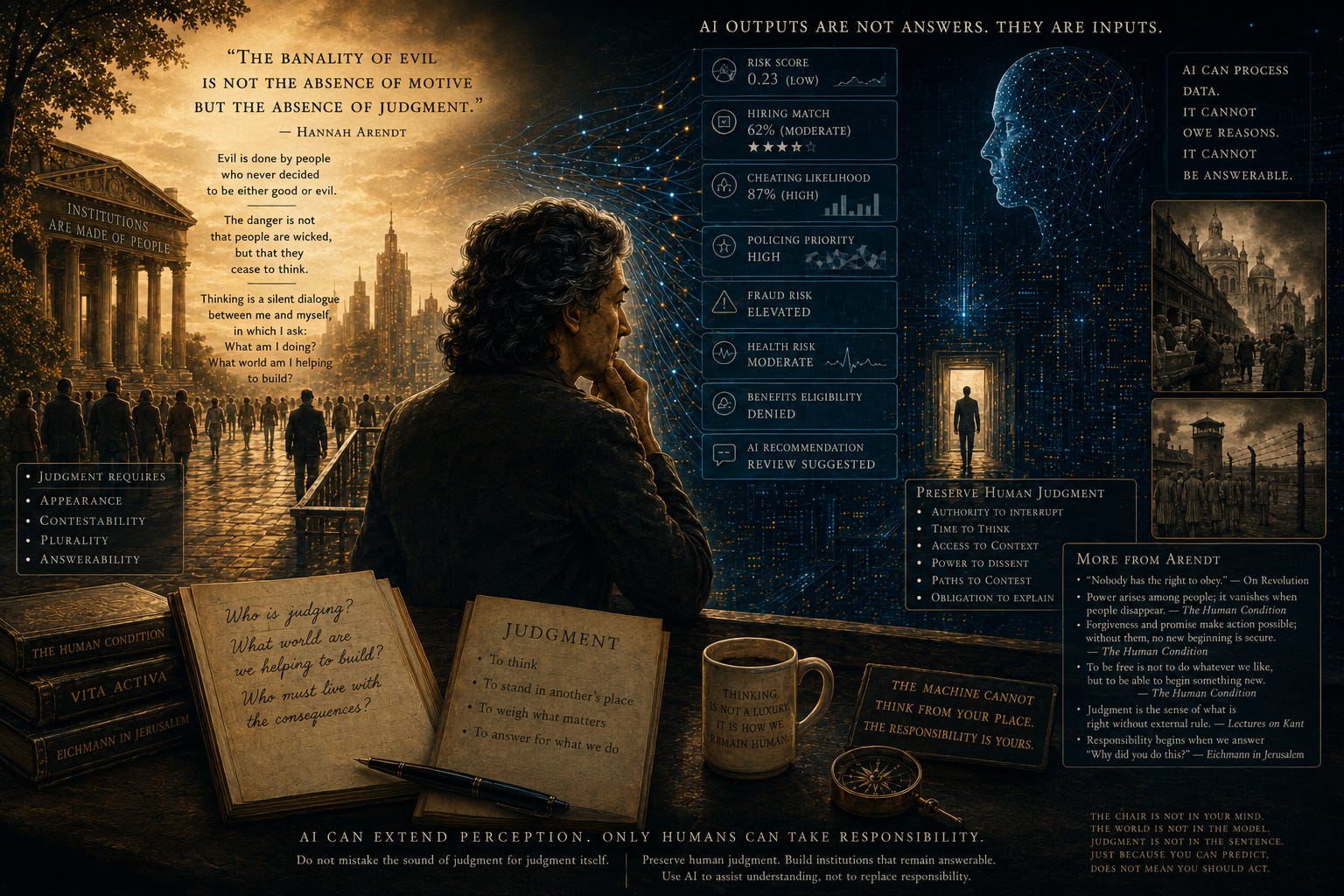
Hannah Arendt would not have been surprised by artificial intelligence. She would have been suspicious of the relief it offers.
Not because machines are demonic, or are beneath us, or above us. Not every act of automation is a betrayal of the human. Arendt was too serious a thinker for that kind of nostalgia. She understood that modern life depends on tools, systems, procedures, and institutions no ancient city could have imagined. Her worry was subtler. The danger begins when human beings discover that they can act without judging, obey without thinking, and participate in vast consequences without ever quite appearing to themselves as responsible.
That is why Arendt belongs near the center of our conversation about AI.
The public argument about artificial intelligence is often staged as a contest over intelligence, power, and control. Can machines reason? Can they replace workers? Can they be aligned? Can they be regulated? These are real questions. But they do not reach the deepest political and moral problem. The deepest problem is not whether AI can make judgments. It is whether human beings, surrounded by systems that classify, recommend, rank, summarize, predict, and decide, will still understand themselves as answerable for judgment.
AI does not need to become conscious to alter the conditions of responsibility. It only needs to become useful enough, fast enough, and institutionally convenient enough that its outputs begin to function as reasons.
A model says the patient is low-risk. A hiring system says the candidate is a weak match. A school platform says the student probably cheated. A policing tool says this neighborhood deserves attention. A fraud model says the applicant looks suspicious. A chatbot says the policy permits denial. A dashboard says the intervention worked.
Each output may be probabilistic, partial, and contestable. Yet inside an institution, such outputs often acquire a strange solidity. They become not merely claims about reality, but handles by which reality is administered.
That is where Arendt’s question returns: who is judging?
Arendt’s moral vocabulary was formed by the catastrophes of the twentieth century, but one of her most enduring insights concerns an ordinary human temptation. People do not usually abandon judgment because they announce themselves as enemies of morality. They abandon it because the situation has been arranged so that judgment seems unnecessary, inefficient, disloyal, or above their station. They speak in clichés. They follow procedure. They appeal to necessity. They become fluent in the language of systems.
The phrase most associated with Arendt, “the banality of evil,” is often misunderstood as a claim that evil is trivial. Her point was more disturbing. Great wrongs can be carried out by people who are not grand villains, people who have lost or refused the habit of thinking from the standpoint of others. The failure is not merely intellectual. It is a failure of judgment: the collapse of the inner activity by which a person asks, “What am I doing? What world am I helping to build? Who must live with the consequences of this act?”
Artificial intelligence enters this scene not as a new Eichmann, not as a bureaucrat with silicon motives, but as a powerful new alibi for thoughtlessness. It can make institutional action appear more objective than it is, more necessary than it is, and less personal than it remains.
This does not mean that every AI system is morally suspect. The differences matter. A spelling assistant is not a sentencing recommendation. A weather model is not a welfare eligibility system. A tool that helps a radiologist notice anomalies is not the same as an automated insurer denying care. A model used by one person to brainstorm is not the same as a platform used by a government agency to triage thousands of claims.
Scale matters. Stakes matter. Reversibility matters. The vulnerability of affected people matters. The ability to contest a decision matters. So does the institutional setting in which the system’s output appears.
Arendt helps us see why these distinctions are not technical footnotes. They are the substance of judgment.
The central question is not “Should humans remain in the loop?” That phrase is too thin. A human can be in the loop like a signature is in the loop: present, required, and morally decorative. A nurse, teacher, judge, manager, caseworker, or officer may technically retain authority while practically being trained to defer. The machine frames the situation, selects the salient features, supplies the category, and presents the likely answer. The human then “reviews” the result under time pressure, policy pressure, productivity pressure, and the quiet intimidation of quantified confidence.
When that happens, the human in the loop becomes the human on the hook.
The institution receives the efficiencies of automation while retaining a person to absorb blame. The official can say the model only advised. The vendor can say the client made the final decision. The manager can say the employee had discretion. The employee can say the system recommended it. Responsibility is not eliminated. It is distributed until it becomes hard to find.
Arendt worried about forms of rule in which people are governed by nobody in particular. Bureaucracy, for her, was not simply paperwork. It was rule by an apparatus in which everyone can claim to be merely performing a function. AI can intensify this condition by adding a new layer of computational authority to administrative life. The danger is not rule by robots. It is rule by nobody, with better dashboards.
The most important AI systems increasingly do more than answer questions. They help decide what counts as visible. They sort signals from noise. They convert messy lives into features. They compress histories into scores. They translate uncertainty into administrative categories. They make some claims easy to state and others nearly impossible to register. This is a reality-indexing power. It is the power to shape how an institution knows the world before anyone asks what should be done.
Consider a school using an AI system to detect plagiarism or cheating. At one level, this is a narrow technical question: how accurate is the detector? But the deeper question is institutional. What picture of the student does the system invite? Does it make teachers more attentive to learning, or more suspicious of style? Does it create a path for explanation, or does it force students to prove innocence against a tool they cannot inspect? Does it detect misconduct, or does it train a community to treat statistical irregularity as moral evidence?
The same structure appears elsewhere. A hospital risk model may help clinicians allocate attention, but it may also encode prior patterns of unequal treatment. A hiring model may reduce some forms of arbitrariness while creating new ones. A benefits system may speed up routine approvals while making exceptional lives illegible. A general-purpose chatbot may help citizens navigate a public agency, but if it becomes the main interface between person and state, its errors are not merely errors. They become the voice of authority.
This is why the moral evaluation of AI cannot stop at accuracy.
Accuracy matters, especially where life chances are at stake. But a system can be accurate in one sense and still deform judgment in another. It can predict a proxy while hiding the human meaning of the case. It can optimize an institutional goal while narrowing the range of reasons officials are able to hear. It can reduce average error while making certain kinds of error harder to challenge. It can make a process faster while making the affected person less real to the decision-maker.
Arendt’s account of judgment is often associated with what she called representative thinking: the capacity to think from the standpoint of others without surrendering one’s own responsibility. To judge well is not simply to apply a rule, and it is not simply to express a preference. It is to move imaginatively among perspectives, to ask how the world appears from where others stand, and then to speak or act in one’s own name.
This is precisely what AI cannot do.
A model can simulate perspectives. It can summarize stakeholder concerns. It can produce a plausible paragraph in the voice of a patient, applicant, defendant, parent, worker, or citizen. Such simulations may be useful. They may widen attention. They may reveal that an institution has failed to consider someone it should have considered.
But simulation is not answerable presence. The person affected by a decision is not a data point wearing a narrative costume. She is someone to whom reasons may be owed.
That difference should guide how we use AI.
There are humane uses of these systems. AI can help a doctor search medical literature, a lawyer find relevant precedent, a teacher generate alternative explanations, a public servant identify overlooked cases, a journalist examine large archives, or a citizen understand a complex rule. In these uses, AI may support judgment by multiplying the materials available to it. It can slow premature closure. It can reveal patterns that a person might miss. It can give language to uncertainty. It can help us ask better questions.
But the same system, placed differently, can shrink judgment. It can seat a value before deliberation begins. It can prime the user to treat efficiency as fairness, prediction as destiny, correlation as explanation, compliance as care. A triage model may quietly teach an organization that the most important question is throughput. A productivity tool may teach a workplace that measurable output is the whole of contribution. A content-ranking system may teach a public that attention is the same as significance. A decision-support system may teach officials that the right answer is the one easiest to defend later.
These are not science fiction concerns. They belong in procurement meetings, professional codes, classroom policies, hospital boards, courts, product reviews, and public law. The question is not only what the model can do. It is what the model makes easier to ignore.
An Arendtian approach to AI would begin with several disciplines of attention.
First, ask what kind of system this is. Is it a private assistant, a recommender, a classifier, a generator, a surveillance system, an agent that acts across tools, or an infrastructure layer through which many other decisions pass? We should not speak of “AI” as if a poem generator and a border-control risk system presented the same moral problem.
Second, ask where the output enters the chain of action. Does it merely inform a person who is free to reject it? Does it frame the options? Does it trigger consequences automatically? Does it create a record that follows someone? Does it become evidence? Does it become the default?
Third, ask who bears the cost of error. In low-stakes settings, experimentation may be tolerable. In high-stakes settings, especially where people are already vulnerable to institutional power, error is not evenly distributed. A false recommendation may be an inconvenience for one person and a life-altering event for another.
Fourth, ask whether the affected person can appear. Can she know that AI was used? Can she challenge the result? Can she give context? Can she encounter a responsible human being with authority to change the outcome? If not, then the system has not merely automated a task. It has altered the terms of citizenship, employment, care, education, or law.
Fifth, ask what virtues the system cultivates in its users. Does it make professionals more perceptive, careful, and open to correction? Or does it train them in deference, suspicion, speed, and moral distancing?
This last question may be the most Arendtian. We often evaluate technology by outcomes alone. Outcomes matter. But political and moral life also depends on the kinds of people our practices bring into being. A society that automates judgment badly may still contain many decent individuals. But it will habituate them to indecency by procedure.
One might object that human judgment is hardly pure. People are biased, tired, self-interested, inconsistent, prejudiced, and often cruel. This is true. Arendt offers no romance of human wisdom. Her work is a sustained meditation on how badly people can fail.
The point is not that human judgment is automatically better than machine output. The point is that only human beings can be answerable for the world their judgments create.
AI may help us judge, but it cannot relieve us of judgment. It may help us see, but it cannot decide what deserves reverence, mercy, suspicion, patience, or repair. It may identify a pattern, but it cannot take responsibility for what we do with that pattern. It may imitate reasons, but it cannot owe reasons. It may process cases, but it cannot meet a person.
The future of AI will not be decided only by model capability. It will be decided by the moral architecture of institutions. The most important question is whether AI is placed in settings that preserve appearance, contestability, plurality, and answerability—or in settings that allow everyone to disappear behind the system.
Arendt’s warning is not that machines will become persons. It is that persons will become functionaries.
That danger is already familiar. It appears whenever someone says, “The system won’t let me.” It appears whenever a worker knows a result is wrong but lacks the authority to alter it. It appears whenever a citizen cannot find the person responsible for a decision. It appears whenever a professional treats a score as a verdict, a category as a character, a prediction as a fate.
Against this, we need a richer idea of human oversight. Oversight should not mean ceremonial approval. It should mean the power and obligation to interrupt the process for reasons the system cannot contain. It should mean time to think, authority to dissent, access to evidence, documentation of uncertainty, and channels through which affected people can speak. It should mean that when AI is used in high-stakes settings, someone can be asked, “Why did you do this?” and that person can answer in words that are not merely borrowed from the machine.
The promise of AI is real. It can extend perception, reduce drudgery, expose inconsistency, and help institutions serve people better. But that promise will be realized only if we refuse the laziest bargain: more power with less judgment.
Arendt teaches that thinking is not a luxury added to action after the fact. It is one of the ways we remain human while acting in systems larger than ourselves. Judgment begins when we decline to let procedure, ideology, or machinery do our moral living for us.
The machine cannot think from your place. It cannot stand where you stand, answer for what you do, or inhabit the world your decision helps make.
That is not a limitation we should rush to overcome. It is a boundary we should build around.